

Latex Specialty Chemicals
Latex Specialty Chemicals: Comprehensive
Process Optimization and High-Quality Solutions
Professional Technical Support for Latex
Processing—from Coagulation to Post-Processing
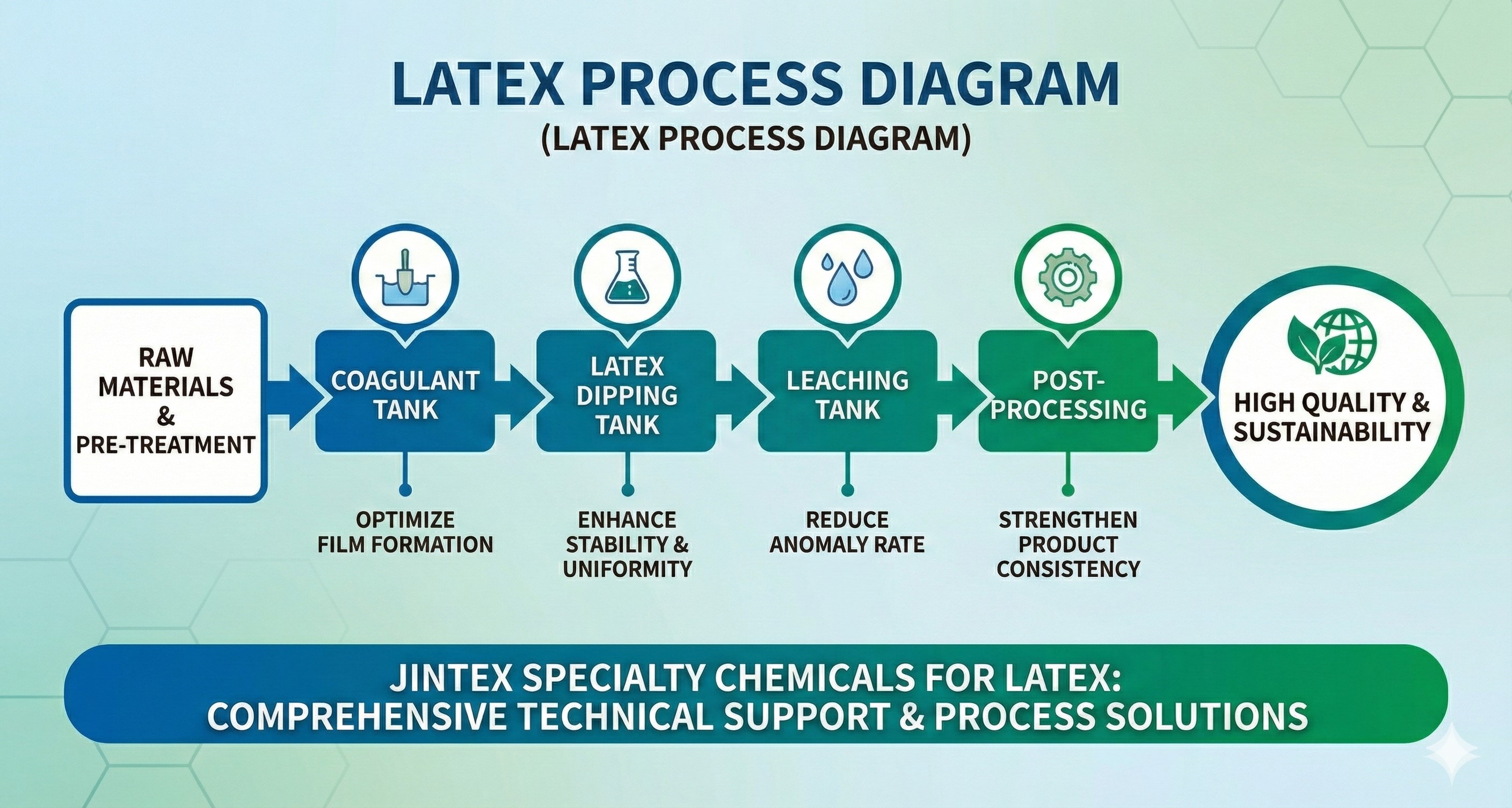
We specialize in providing integrated
application solutions for the latex production process. Our expertise covers
critical manufacturing stages, including Coagulation, Latex Dipping, Leaching,
and Post-processing, where we offer in-depth technical support and process
optimization services.
【Core Advantages】Enhancing Film Quality and Reducing Production Defects
We possess a profound understanding of the
rigorous requirements for film quality, stability, and efficiency throughout
each stage of the latex process. By leveraging our professional latex specialty
chemicals, we assist clients in achieving:
Uniform Film Formation: Improving surface
smoothness and ensuring consistent product thickness.
Quality Reliability: Effectively reducing
pinholes and defect rates while strengthening the physical performance of the
final product.
Production Efficiency: Optimizing
production conditions to minimize downtime and reduce overall operational
costs.
【Sustainability & Innovation】Your Strategic Partner for Green Production
Leveraging our extensive industry
experience and robust R&D capabilities, we provide customized application
designs. Our solutions not only enhance our clients' market competitiveness but
are also strictly aligned with Environmental, Social, and Governance (ESG)
regulations. We are more than just a chemical supplier; we are your long-term
strategic partner dedicated to driving a future of high quality and sustainable
development.
|
Process |
Function |
Product |
Introduction |
|
Coagulant Tank |
Defoamer |
Jindefoam F-6124 |
Ensures uniform film formation and reduces pinholes. |
|
Latex Tank |
Defoamer |
Jindefoam F-6471 |
Promotes uniform latex adhesion, minimizing pinhole defects. |
|
Bio Stabilier |
JinGA AD-26 |
Prevents latex dripping after dipping, ensuring uniform glove thickness. |
|
|
Bio dispersing |
JinGA DS liq |
Enhances NBR latex dispersion and prevents agglomeration. |
|
|
JinGA DS powder |
|||
|
Slip Modifier |
JintexEco PC |
Additive: Maintains release performance even at high line speeds. |
|
|
Pre-Leaching |
Defoamer |
Jindefoam F-6107 |
Ensures no bubble defects adhere to the finished product. |
|
Dipping Tank |
Wet-Hands Donning |
Jintex THR |
Provides wet-grip slip resistance or special surface tactile treatment. |
|
Polymer |
JintexEco MR-P10 |
Additive: Provides wearing comfort. |
System 1: Quality & Surface Control
Q1: Why does the NBR glove dipping tank require "Dual-Action" defoaming technology?
- Key Product: Jindefom F-64 series
- Answer: During dynamic dipping, NBR latex generates both "sub-surface bubbles" and "surface foam." The Jindefom F-64 series features Dual-Action Tech, which simultaneously performs underwater foam inhibition and surface bubble breaking. This ensures that critical areas like fingertips and finger webs remain free of pinholes.
#JINTEX #JindefomF64 #DualActionTech #NBRGloveDefoaming #DippingTankAntifoam #GlovePinholeImprovement #NBRProcessOptimization
Q2: How can "Zero Oil Spots" be achieved in the NBR glove manufacturing process?
- Key Product: Jindefom F-64 series
- Answer: Oil spots often originate from residual silicone-based defoamers. Utilizing the 100% Silicone-free formula of the Jindefom F-64 series eliminates surface contamination at the source, ensuring coating adhesion after film formation. As non-silicone defoamers rely heavily on high-quality emulsification stability, Jindefom represents the pinnacle of JINTEX R&D. It provides essential support for automated production lines seeking high quality and low-risk management.
#ZeroOilSpots #SiliconeFreeDefoamer #NonSiliconeDefoamer #EmulsificationStability #Jindefom #GloveSurfaceQuality #RiskManagement #JINTEX_R&D
Q3: What is the precision solution for micro-bubbles at the "Air-liquid Interface"?
- Key Product: Jindefom F-64 series
- Answer: Fine bubbles at the interface are most difficult to eliminate the moment the former enters the latex. The Jindefom F-64 series possesses exceptional dynamic diffusion power, allowing it to precisely eliminate micro-bubbles at a minimal dosage. This ensures uniform glove thickness and a flawless finish.
#AirLiquidInterface #FormerBubbleElimination #FineBubbleElimination #MinimalDosage #JindefomF64 #NBRDippingProcess #UniformGloveThickness
Q4: Why must the "Coagulant Tank" also use a dedicated high-efficiency defoamer?
- Key Product: Jindefom Series Specialized Defoamers
- Answer: Foam on the surface of the coagulant tank severely interferes with the integrity of the initial latex film formation. Incomplete surface filming leads to pinholes or weak spots in the finished glove. Adding a specialized defoamer to the coagulant tank quickly maintains a smooth liquid surface, ensuring the former is evenly coated with coagulant and preventing film defects from the earliest stage of the process.
#CoagulantTank #CoagulantDefoamer #FilmIntegrity #PreventGlovePinholes #Jindefom #NBRPreProcess #GloveSurfaceDefectControl
System 2: Process Stability & Efficiency
Q5: How can "Shear Instability" and agglomeration be prevented in continuous NBR latex production?
- Key Product: JinGA AD-26
- Answer: The shear force generated during continuous pumping can disrupt the charge balance of the latex. Adding JinGA AD-26 (a high-efficiency stabilizer) enhances the electrostatic repulsion between particles and improves Mechanical Stability (MST). This offers significant benefits for maintaining long-term production continuity and reducing downtime for cleaning.
#JinGAAD26 #NBRLatexStabilizer #MechanicalStability #MSTImprovement #ShearInstability #LatexStabilizer #JINTEX #ProductionContinuity
Q6: Why is the use of "Liquid" dispersants strongly recommended to prevent sedimentation in compounding formulas?
- Key Product: JinGA DS liq
- Answer: Dispersants are essential additives for maintaining quality during the compounding process. JinGA DS liq effectively opens up fillers or agglomerated emulsions, lowering viscosity and ensuring optimal flow properties of the slurry.
- Compared to traditional solid products, the liquid JinGA DS liq offers major advantages: it easily integrates with automated dosing systems, is extremely convenient to handle, and significantly reduces the time required for pre-solution preparation. Furthermore, it can be added instantly as an emergency fix for viscosity abnormalities, making it key to maintaining production yield.
#JinGADSliq #CompoundedLatex #LiquidDispersantAdvantages #AutomatedDosingSystem #EmergencyAdditive #ViscosityControl #CompoundingEssential #JINTEXExpertise
Q7: Why does choosing a chemical supplier with an AEO spirit improve "Manufacturing Efficiency"?
- Key Product: JINTEX Full Range of Auxiliaries
- Answer: Manufacturing efficiency stems from Supply Chain Security and a broad supply network (e.g., Taiwan, Vietnam, China, India, Indonesia). Choosing a brand like JINTEX, which focuses on quality consistency and risk control, reduces batch-to-batch fluctuations. This ensures production lines reach Maximum Yield while complying with international regulations.
#AEOAuthorizedEconomicOperator #JINTEXSupplyChain #ManufacturingEfficiency #MaximumYield #SupplyChainSecurity #GlobalChemicalSupply #QualityConsistency #RiskManagement
Q8: Is there an immediate fix if the MST value of NBR latex drops after storage?
- Key Product: JinGA AD-26
- Answer: Fluctuations in the storage environment can lead to decreased stability. Adding a small amount of JinGA AD-26 before compounding can quickly restore the chemical stability of the latex. This prevents the formation of a "grainy" texture during the dipping process and serves as an essential "rescue" auxiliary for maintaining high-quality production.
#LatexMST #LatexRestoration #JinGAAD26 #NBRRawMaterialManagement #ChemicalStability #GloveProductionRescue #JINTEXTechnicalSupport
System 3: Sustainability & Functional Enhancement
Q9: Are there filler solutions for ESG green tenders that lower carbon footprints and "reduce equipment cleaning costs"?
- Key Product: Jintex THR
- Answer: To reduce dependence on fossil-based raw materials, Jintex THR provides a Bio-based filler option. When added directly to the latex dipping tank, it effectively replaces traditional inorganic solid fillers while maintaining the glove's excellent modulus and softness. Most importantly, using Jintex THR significantly reduces sedimentation in the tank, thereby lowering maintenance costs and the time required for cleaning production equipment.
#JintexTHR #BioBasedFiller #ReplaceInorganicFiller #ReduceTankSedimentation #LowerCleaningCosts #ESGChemicals #LowCarbonGloves #JINTEXGreenSolutions
Q10: How can the "Double-Layer Film" effect and donning comfort be maintained in a "Chlorine-Free" process?
- Key Product: JintexEco MR-P10
- Answer: In response to strict environmental regulations, JintexEco MR-P10 is widely used in chlorine-free processes. Its high flexibility allows it to be applied in both pre-and post-treatment stages. Through compound adjustment with secondary materials or smoothing fillers, it optimizes the cross-linking network. This not only provides excellent density for the second layer but also serves as a perfect alternative to traditional chlorination, giving the inner layer of the glove superior wearing comfort.
#JintexEcoMRP10 #ChlorineFreeProcess #ChlorinationAlternative #DonningComfort #PreAndPostProcess #DoubleLayerEffect #CompoundAdjustment #JINTEXEcoFriendlyAuxiliaries
Q11: How can tearing and damage to thin-gauge gloves be prevented during the "Stripping" process?
- Key Product: JintexEco PC
- Answer: Damage during stripping is often related to Green Strength. JintexEco PC imparts better toughness to the film before vulcanization, significantly reducing the stripping breakage rate.
#JintexEcoPC #StrippingBreakageRate #GreenStrength #ThinGloveProduction #StrippingEfficiency #JINTEXAuxiliaries